In a world increasingly connected by air travel and international trade, the threat of rare infectious diseases reaching cities like Chennai is no longer a distant concern. Ebola Virus Disease (EVD) once confined to remote Central and West African regions has demonstrated, through multiple outbreaks, that it can rapidly become a global health emergency. For residents, healthcare workers, and travellers in Chennai, understanding Ebola is not about spreading panic. It is about being informed, prepared, and protected.
At Oxford Hospitals, Chennai, our Infectious Disease specialists believe that public health education is the first line of defence. This comprehensive guide explains everything you need to know about the Ebola virus in plain, easy-to-understand language so you can protect yourself and your family.
What is Ebola Virus Disease (EVD)?
Ebola Virus Disease is a severe, often fatal illness caused by the Ebola virus, a member of the Filoviridae family. First identified in 1976 near the Ebola River in what is now the Democratic Republic of Congo (DRC), the virus has caused periodic outbreaks the largest of which, the 2014–2016 West Africa epidemic, resulted in more than 11,000 deaths and triggered a worldwide public health emergency.
There are six known species of the Ebola virus, but only four are known to cause disease in humans:
- Zaire ebolavirus the most deadly and most studied species
- Sudan ebolavirus linked to several outbreaks in East Africa
- Bundibugyo ebolavirus identified in Uganda in 2007
- The Forest ebolavirus identified from a single case in Côte d’Ivoire
The fatality rate varies by species and by access to medical care, ranging from 25% to 90%. With modern hospital support, survival rates have significantly improved compared to earlier outbreaks.
How does Ebola Spread? Understanding Transmission
One of the most important facts about Ebola is that it is NOT airborne. You cannot catch Ebola by breathing the same air as an infected person. This is a critical distinction that helps prevent unnecessary fear.
Ebola spreads through direct contact with:
- Blood or body fluids (saliva, sweat, vomit, faeces, breast milk, semen, urine) of a person who is sick with or has died from Ebola
- Objects such as needles and syringes contaminated with body fluids from a person sick with Ebola
- Infected animals fruit bats and non-human primates are the natural hosts
- Consumption of bushmeat (wild animal meat) from infected animals
- Sexual contact with a survivor the virus can persist in semen for up to 12 months after recovery
Who is Most at Risk?
- Healthcare workers without adequate Personal Protective Equipment (PPE)
- Family members and caregivers of infected patients
- People who handle bodies during traditional burial ceremonies
- Travellers returning from Ebola-affected regions
- Laboratory workers handling samples from infected individuals
In the context of Chennai, the primary risk comes from international travel. Chennai’s international airport and port mean that returning travellers from West and Central Africa, or anyone who has been in contact with confirmed Ebola patients, should seek immediate medical screening on return.
Ebola Symptoms Recognising the Warning Signs
Ebola has an incubation period of 2 to 21 days meaning symptoms appear between 2 and 21 days after exposure. A person is not contagious until symptoms appear, which is an important public health reassurance.
Early Symptoms (Days 1–5)
- Sudden onset of fever (temperature above 38.5°C)
- Severe headache
- Muscle pain and body ache
- Sore throat
- Weakness and extreme fatigue
- Loss of appetite
Progressive Symptoms (Days 5–10)
- Vomiting and diarrhoea (often severe)
- Stomach pain and cramping
- Rash on the body
- Impaired kidney and liver function
- In some cases: unexplained bleeding or bruising (internal or external)
Severe Late-Stage Symptoms
- Bleeding from the gums, eyes, nose, or in stool
- Low blood pressure and shock
- Multi-organ failure
- Delirium or confusion
Important: Early Ebola symptoms closely resemble those of malaria, typhoid fever, dengue, and COVID-19. If you have recently travelled to West or Central Africa and develop any of these symptoms, contact Oxford Hospitals immediately for evaluation do not self-diagnose.
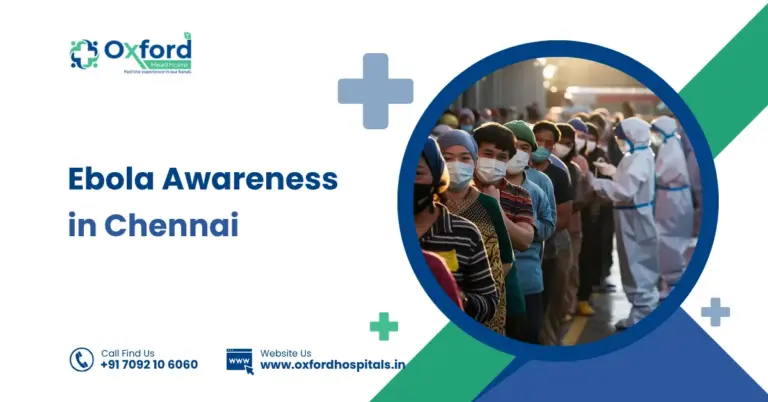
Ebola Awareness in Chennai why it Matters Here
Chennai is Tamil Nadu’s capital and one of India’s major international gateways, with thousands of passengers arriving weekly via Chennai International Airport. While India has not reported any confirmed Ebola cases, the city and Chennai specifically must remain vigilant.
International Travel and Trade
Chennai’s well-connected air routes to Africa mean that travellers, migrant workers, and business visitors can inadvertently carry emerging infections. During the 2014 West Africa Ebola outbreak, India’s Ministry of Health and Family Welfare issued travel advisories and set up screening at Chennai airport.
Healthcare Tourism
Chennai is a top destination for medical tourism, attracting patients from African countries. Oxford Hospitals screens international patients and follows WHO and ICMR protocols for infectious disease management.
Port Activity
As a major port city, Chennai receives cargo and crew from international vessels. Biosecurity checks at Chennai Port Trust form part of India’s defence against imported infectious diseases.
India’s Preparedness
The Indian Council of Medical Research (ICMR), the National Centre for Disease Control (NCDC), and the Tamil Nadu Department of Health have established protocols for EVD surveillance, rapid response, and containment. Oxford Hospitals actively collaborates with these bodies to ensure Chennai is prepared.
How is Ebola Diagnosed?
Diagnosing Ebola is challenging because early symptoms overlap with many common tropical diseases. Laboratory confirmation is essential. Diagnosis is conducted using:
- RT-PCR (Reverse Transcription Polymerase Chain Reaction) the gold standard; detects viral RNA in blood within 72 hours of symptom onset
- ELISA (Enzyme-Linked Immunosorbent Assay) detects antibodies or antigens
- Antigen Rapid Diagnostic Tests (RDTs) for field use in resource-limited settings
- Virus isolation in BSL-4 (Biosafety Level 4) laboratories
In India, reference laboratory testing is conducted at ICMR’s National Institute of Virology (NIV) in Pune, which is equipped with the necessary biosafety infrastructure. Samples from suspected cases in Chennai are dispatched to NIV following strict transport protocols.
Clinical note for doctors: Always take a detailed travel history. A patient presenting with fever, vomiting, and diarrhoea who has travelled to the DRC, Guinea, Sierra Leone, Liberia, or Uganda in the past 21 days should be considered for EVD screening and isolated immediately while awaiting test results.
Treatment Options for Ebola
There is currently no universally approved antiviral cure for Ebola, but the landscape has changed dramatically in recent years. Treatment combines supportive care with, where available, targeted therapies.
Supportive Care (The Foundation of Treatment)
- Aggressive intravenous (IV) fluid and electrolyte replacement to manage severe dehydration
- Maintenance of blood pressure and oxygen levels
- Treatment of secondary infections with antibiotics
- Management of pain, fever, and nausea
- Nutritional support and intensive nursing care
Approved Therapies
- Atoltivimab/Maftivimab/Odesivimab (Inmazeb™) FDA-approved in 2020 for Zaire ebolavirus infection in adults and children. It is a three-antibody combination therapy that has shown significant survival benefit.
- Ansuvimab (Ebanga™) Also FDA-approved in 2020; a single monoclonal antibody that demonstrated 78% survival in clinical trials compared to control groups.
Investigational Treatments
- Remdesivir (an antiviral also studied for COVID-19) currently under investigation for Ebola
- ZMapp an older monoclonal antibody therapy used in the 2014 outbreak
- Convalescent plasma using plasma from Ebola survivors, containing protective antibodies
At Oxford Hospitals, our Intensive Care Medicine and Infectious Disease departments are equipped to provide full supportive care. Confirmed Ebola patients would be managed in coordination with national authorities in government-designated isolation facilities with the highest level of biosafety.
Prevention how to Protect yourself and your Family
Prevention remains the most powerful tool against Ebola. Because the virus requires direct contact with body fluids for transmission, standard protective measures are highly effective.
For the General Public
- Avoid travel to active Ebola outbreak zones unless absolutely necessary
- If you must travel, follow all advisories from the WHO, Ministry of Health, and ICMR
- Avoid contact with blood or body fluids of sick individuals
- Do not handle bats, primates, or their meat without proper protection
- Avoid consuming undercooked bushmeat
- Wash hands frequently with soap and water, or use an alcohol-based hand sanitiser
- If you feel unwell after returning from a high-risk region, self-isolate and call a doctor immediately
For Healthcare Workers
- Use full Personal Protective Equipment (PPE): gloves, gown, face shield, N95 mask, and shoe covers when managing suspected cases
- Follow strict hand hygiene protocols before and after every patient contact
- Safely dispose of all needles, sharps, and contaminated materials
- Follow hospital isolation protocols for any suspected viral haemorrhagic fever
- Report suspected cases to hospital infection control and state health authorities immediately
For Travellers
- Register your travel with the Indian Embassy in high-risk countries
- Get vaccinated if approved vaccines are available and recommended for your destination
- Report any illness within 21 days of return from an affected region to your doctor
- Always inform healthcare providers of your full travel history when seeking medical care
Ebola Vaccines A Breakthrough in Prevention
One of the most significant medical advances of the last decade has been the development of effective Ebola vaccines, which have transformed outbreak response worldwide.
rVSV-ZEBOV (Ervebo®)
Developed by Merck and approved by the FDA and EMA in 2019, Ervebo is a live attenuated recombinant vaccine that protects against the Zaire ebolavirus the species responsible for most major outbreaks. Clinical trials in Guinea showed a vaccine efficacy of approximately 100% using a ring vaccination strategy.
Ad26.ZEBOV + MVA-BN-Filo (Zabdeno® + Mvabea®)
This two-dose vaccine regimen, approved by the EMA, uses a heterologous prime-boost approach. It offers broader protection and is currently used in healthcare workers and high risk communities in the DRC and neighbouring countries.
Availability in India
As of now, Ebola vaccines are not commercially available in India for routine use. They are deployed in outbreak zones under WHO and government oversight. However, Indian pharmaceutical partners, including the Serum Institute of India, have expressed interest in manufacturing or stockpiling these vaccines for rapid deployment in an emergency.
Myths vs Facts About Ebola
Misinformation during outbreaks causes fear, stigma, and dangerous behaviour. Here are key facts to set the record straight:
MYTH: “Ebola spreads through the air like the flu.”
FACT: Ebola requires direct contact with body fluids. It is NOT transmitted through casual contact, air, water, or food.
MYTH: “If you touch someone with Ebola, you will get it.”
FACT: You are not at risk from casual contact such as sitting next to someone. Risk comes only from contact with their blood or body fluids.
MYTH: “Ebola always leads to death.”
FACT: With early and proper medical care, survival rates have improved dramatically. The 2018–2020 DRC outbreak saw survival rates of over 60% in patients treated with approved monoclonal antibody therapies.
MYTH: “There is no treatment for Ebola.”
FACT: Two FDA-approved monoclonal antibody therapies Inmazeb™ and Ebanga™ are now available and highly effective.
MYTH: “Ebola is spreading in Chennai right now.”
FACT: As of the date of this article, there are no reported or suspected Ebola cases in Chennai or anywhere in India.
MYTH: “Eating garlic or herbal remedies can cure Ebola.”
FACT: No traditional remedy, herb, or food has any proven effect on Ebola. Always seek professional medical care if you suspect exposure.
What should you do if you Suspect Ebola?
If you or someone you know has recently returned from an Ebola-affected region and develops fever, vomiting, diarrhoea, or unexplained bleeding within 21 days, take these steps immediately:
- Do NOT go to a hospital emergency room unannounced — call ahead so staff can prepare
- Call Oxford Hospitals Helpline: +91 7092 10 6060
- Avoid contact with others and do not use public transport
- Inform the caller of your symptoms AND your recent travel history
- Follow all instructions from the healthcare provider over the phone
- If directed to come in, cover your nose and mouth with a cloth mask during travel
Our trained triage team will assess you, guide you to a dedicated isolation area, and coordinate with Tamil Nadu Health Authorities if EVD is suspected. Early reporting is critical both for your own safety and for protecting others.
How Oxford Hospitals Keeps Chennai Safe
Oxford Hospitals is one of Chennai’s leading multispeciality healthcare institutions, and our Infectious Disease department is at the forefront of disease surveillance and emergency preparedness.
Our Capabilities Include:
- Dedicated Isolation Facilities for managing suspected or confirmed cases of viral haemorrhagic fevers
- Trained Infectious Disease Specialists available for rapid consultation
- 24/7 Emergency Medicine services with triage protocols for travel-related illnesses
- Coordination with ICMR, NCDC, and Tamil Nadu Health Department for outbreak response
- Regular staff training on PPE protocols, biosafety, and infection control
- Advanced Laboratory Services for rapid diagnostic support
- Intensive Care Medicine (ICU/ICCU) for critical patient management
Our Commitment to you
At Oxford Hospitals, we are committed to keeping our community informed, safe, and cared for. Whether you are a concerned patient, a returning traveller, or a healthcare professional, our helplines are always open. Our approach is built on compassion, expertise, and transparency.
Conclusion
Ebola Virus Disease is one of the most formidable infectious diseases known to medicine. But it is not inevitable, uncontrollable, or untreatable. With the right knowledge, appropriate precautions, and timely medical care, the risk can be effectively managed even in a major metropolis like Chennai.