

A soft tissue injury condition refers to damage that affects muscles, ligaments, tendons, and other connective tissues that support the human body. These tissues play a critical role in movement, stability, and flexibility. When they are overstretched, torn, or impacted by trauma, it leads to pain, swelling, and reduced mobility.
Soft tissue injuries are among the most common musculoskeletal problems seen in sports medicine and orthopedics. They range from mild strains that heal quickly to severe tears that require surgical intervention. In most cases, early diagnosis and proper management significantly improve recovery outcomes. From a clinical perspective, soft tissue damage is not always visible externally, which is why imaging and physical examination are important for accurate diagnosis.
Meaning of Soft Tissue in the Human Body
Soft tissues are the supportive structures of the body that are not bone. These include:
- Muscles (responsible for movement)
- Tendons (connect muscles to bones)
- Ligaments (connect bones to each other)
- Fascia (connective tissue covering muscles)
- Blood vessels and nerves
When any of these structures are injured, it results in soft tissue damage, which may lead to inflammation, pain, and functional limitations. These tissues are elastic but not indestructible. Excessive force, repeated stress, or sudden trauma can exceed their capacity and cause injury.
Difference between Soft Tissue and Bone Injury
Soft tissue injuries and bone injuries are often confused, but they are medically different:
- Soft tissue injury affects muscles, ligaments, and tendons
- Bone injury involves fractures or cracks in bones
Soft tissue injuries are usually diagnosed using MRI or ultrasound, while bone injuries are more easily visible on X-rays. Healing time also differs soft tissues may heal faster in mild cases but can take longer in severe tears due to limited blood supply.
Why Soft Tissue Injuries are Common
Soft tissue injuries occur frequently because these tissues are constantly active in daily life. Even simple movements like walking, bending, or lifting involve muscles and tendons.
Common reasons include:
- Sudden force or impact
- Repetitive movement
- Poor posture
- Lack of warm-up before exercise
- Overuse during sports or work
Athletes, office workers, and manual laborers are particularly at risk due to continuous stress on specific muscle groups.
Types of Soft Tissue Injuries
- Sprains (ligament injuries): Sprains occur when ligament injuries are stretched beyond their normal range or torn. They commonly affect ankles, wrists, and knees. Symptoms include swelling, pain, and joint instability.
- Strains (muscle or tendon injuries): Strains occur when muscles or tendons are overstretched or torn. These injuries are common during lifting heavy objects or sudden sprinting.
- Contusions (bruises): Contusions happen due to direct impact on the body, causing internal bleeding under the skin. This leads to visible bruising and tenderness.
- Tendonitis (overuse injury): Tendonitis is inflammation of a tendon due to repetitive motion. It is common in athletes, typists, and workers performing repetitive tasks.
- Bursitis (inflammation of fluid sacs): Bursae are small fluid-filled sacs that reduce friction between tissues. When inflamed, they cause pain and stiffness in joints.
- Severe tears (ligament or tendon rupture): Severe injuries involve complete tearing of soft tissues. These are serious conditions requiring medical intervention and sometimes surgery.
Causes of Soft Tissue Injury
- Sports and physical activity injuries: Sports activities such as football, cricket, running, and gym workouts are leading causes of soft tissue injuries due to sudden acceleration, twisting, and impact.
- Sudden trauma (falls, accidents, collisions): Accidents can cause immediate and severe soft tissue damage, especially in the knees, shoulders, and back.
- Overuse or repetitive strain: Repeated actions without adequate rest can lead to microscopic tears that gradually worsen over time.
- Poor posture or wrong movement techniques: Incorrect posture during sitting, lifting, or exercising puts uneven pressure on muscles and ligaments.
- Work-related injuries: Jobs involving heavy lifting, bending, or repetitive motion significantly increase injury risk.
Symptoms of Soft Tissue Injury
- Pain and tenderness: Pain is the most common symptom and may worsen with movement or pressure.
- Swelling and inflammation: Inflammation occurs as the body attempts to heal damaged tissues.
- Bruising or discoloration: Internal bleeding causes visible skin discoloration.
- Limited movement or stiffness: Joint or muscle movement becomes restricted.
- Weakness in the affected area: Muscles may lose strength due to injury or inflammation.
How Serious can a Soft Tissue Injury be?
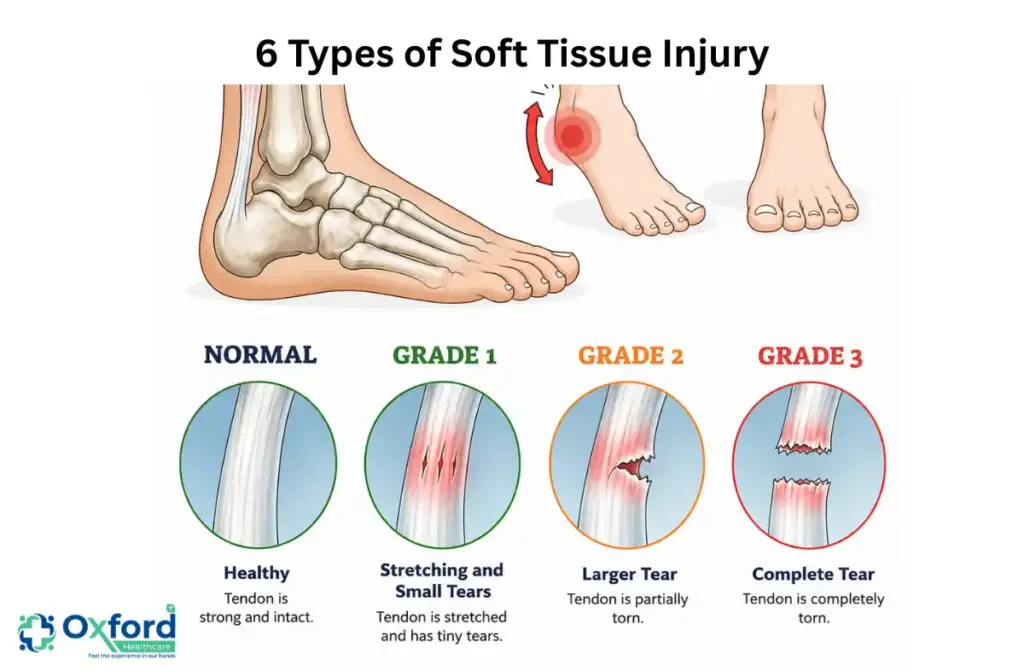
- Mild injuries (Grade 1): Minor stretching of fibers with slight discomfort. Healing is usually quick.
- Moderate injuries (partial tear): Significant fiber damage causing pain, swelling, and reduced mobility.
- Severe injuries (complete tear): Full rupture of ligaments or tendons requiring medical intervention.
When it becomes an emergency condition
Immediate care is needed when:
- Severe pain occurs suddenly
- Joint appears deformed
- Movement is impossible
Diagnosis of Soft Tissue Injury
- Physical examination by doctor: Doctors assess pain level, swelling, and mobility.
- Patient history and injury details: Understanding how injury occurred helps determine severity.
- Imaging tests (X-ray, MRI, CT scan): MRI is most effective in identifying soft tissue damage, especially in deep structures like the knee.
When imaging is necessary
Imaging is recommended if:
- Pain persists beyond a few days
- Severe swelling occurs
- Ligament or tendon tear is suspected
Treatment for Soft Tissue Injury
RICE method (Rest, Ice, Compression, Elevation)
The RICE method is the first step in reducing swelling and pain.
- Pain management medications: Anti-inflammatory drugs help control pain and swelling.
- Physiotherapy and rehabilitation: Rehabilitation restores strength and flexibility.
- Bracing or support devices: Supports stabilize injured joints during recovery.
- Surgery (for severe cases): Required in complete tears or major ligament injuries.
Soft Tissue Injury Knee Treatment
The knee is one of the most commonly affected joints. Soft tissue injury knee treatment depends on severity. Mild cases are treated with rest and physiotherapy, while severe cases may require surgical repair.
Proper rehabilitation is essential to prevent long-term instability and re-injury.
Recovery Time for Soft Tissue Injury
- Mild injury recovery timeline (days to weeks): Minor injuries heal within 1–3 weeks.
- Moderate injury recovery (weeks to months): Partial tears may take 4–12 weeks depending on care.
- Severe injury recovery (months or surgery cases) Severe injuries may require 3–6 months or longer.
Factors affecting healing speed
- Age and fitness level
- Severity of injury
- Nutrition and hydration
- Rehabilitation adherence
knee soft tissue injury recovery time
- The knee soft tissue injury recovery time depends on ligament involvement. Mild sprains recover quickly, while ACL or major ligament injuries may take months.
- knee soft tissue injury healing time
- The knee soft tissue injury healing time improves significantly with early physiotherapy, controlled movement, and proper medical supervision.
Complications of Untreated Soft Tissue Injury
If ignored, soft tissue injuries may lead to:
- Chronic pain: Long-term discomfort due to incomplete healing.
- Joint instability: Weak ligaments can cause repeated injuries.
- Muscle weakness: Loss of strength due to disuse.
- Long-term inflammation: Persistent swelling can damage surrounding tissues.
- Reduced mobility: Difficulty in movement affects daily life.
How to Prevent Soft Tissue Injuries
- Warm-up before exercise: Prepares muscles for physical stress.
- Proper technique during activities: Reduces strain on ligaments and muscles.
- Regular stretching and strengthening: Improves flexibility and resilience.
- Avoid overtraining: Rest is essential for recovery and prevention.
- Workplace ergonomics: Correct posture reduces repetitive strain injuries.
When to see a Doctor
Seek medical help if:
- Pain is severe or persistent
- You cannot move the joint
- Swelling increases over time
- Injury does not improve in a few days
Early diagnosis prevents long-term complications.
Conclusion
Soft Tissue Injuries are common but should always be taken seriously. They may start as mild discomfort but can progress into severe mobility problems if ignored. Understanding the nature of soft tissue damage, recognizing early symptoms, and following proper treatment protocols can significantly improve outcomes. Specific conditions like soft tissue injury knee treatment require targeted rehabilitation to restore full joint function. Similarly, awareness of knee soft tissue injury recovery time and knee soft tissue injury healing time helps patients set realistic expectations and follow recovery plans effectively. With timely care, most soft tissue injuries heal completely, allowing individuals to return to normal activity safely and confidently.